
Manufacturing Capabilities
Application Engineering & Manufacturing
Nonwoven Product Development and Mass Production — From Material Selection and Process Design to Equipment Compatibility
Finding the right material is only the starting point. Yi-Ting is one of the few specialized manufacturers in Taiwan dedicated to food filtration materials and packaging material processing. Starting from actual application requirements, we support material selection, process design, forming and sealing conditions, prototype validation, and equipment compatibility.
We can also work backward from the product requirements to identify potential adjustments to filling and packaging equipment.
With nearly 30 years of experience in nonwoven manufacturing, Yi-Ting works closely with customers to progressively transform their requirements into products that can be manufactured consistently and reliably at scale.

Application Engineering
We Do Not Start by Deciding How to Manufacture — We Start by Understanding What the Product Needs to Solve
1. Customers Bring the Requirements — Yi-Ting Breaks Them Down and Evaluates the Right Approach
Even for the same nonwoven bag, requirements can vary significantly depending on the application. Load-bearing capacity, water resistance or permeability, breathability or barrier properties, opacity, printability, and other characteristics may all require different specifications.
Compatibility with downstream processing equipment is also an important consideration.
Yi-Ting first identifies the product application, existing technology, and critical performance requirements, then evaluates the material, structure, processing method, and equipment compatibility as an integrated system.
If the original requirements are not the most suitable solution, we also work backward from the intended application to propose alternative materials or manufacturing processes, seeking a more efficient and advantageous approach.
2. Is a Flat-Open Bag Really Just a Bag?
Confirm the Requirements and Application Before Designing and Integrating the Manufacturing Process
Once the material and functional direction have been confirmed, the next step is process design.
With 50 active processing machines across 15 equipment categories, Yi-Ting can configure different processing routes according to material, dimensions, structure, and mass-production requirements.
Rather than applying every product to the same fixed production line, we develop a flexible manufacturing process based on the specific requirements and production conditions of each product.
SLITTING
REWINDING
CROSS CUTTING
LAMINATION
FORMING
BAG MAKING
SEALING
CUTTING
PACKAGING
Take a bag product as an example. Although the finished product appears to be a single bag, its actual manufacturing process may require three separate operations: slitting, folding, and seal cutting, involving three different machines.
Customers can provide their requirements through product images or engineering drawings, while Yi-Ting plans and discusses the appropriate manufacturing process based on the product specifications.
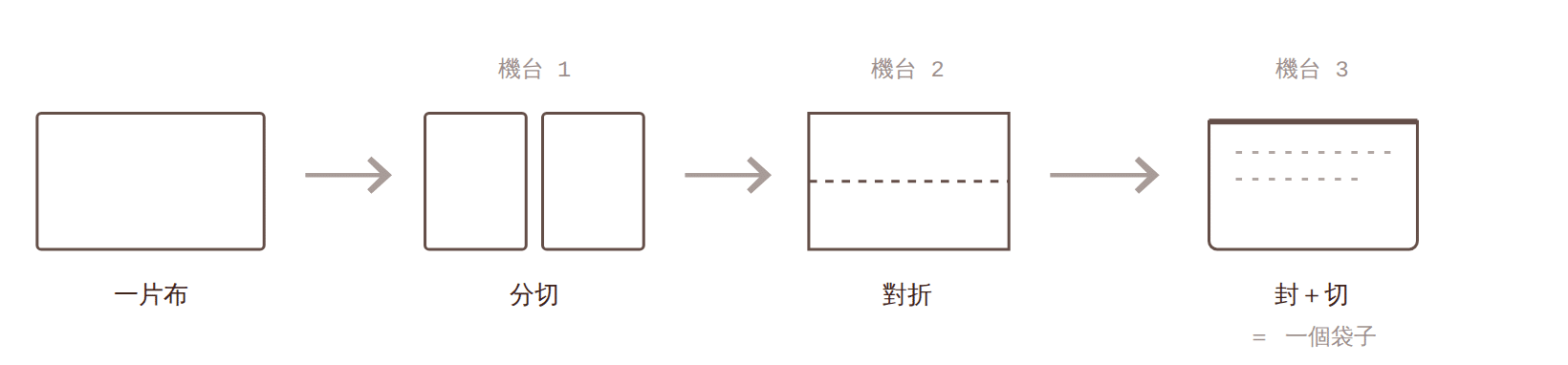
Lowering Development Barriers Through Existing Equipment and Tooling
By combining existing production equipment, tooling, and process expertise, some products can proceed directly to sampling or mass production without requiring dedicated tooling or additional equipment.
If greater product differentiation is required, Yi-Ting evaluates the need for dedicated tooling or specialized equipment based on the product structure, production volume, and mass-production conditions.
Lowering Initial Volume Requirements During Product Development
Tooling Options
Flexible Production Capacity Allocation
Application Example
Customer Case
An overseas customer approached us with an existing specification for a 50 GSM spunbond nonwoven bag and was looking for a new supply solution.
After an initial evaluation, we found that reproducing the existing product structure exactly would require dedicated equipment. Rather than immediately treating “Can it be manufactured as specified?” as the only question, our team further explored the bag’s actual application and target cost.
After receiving the sample, we planned to reassess the material strength, basis weight, surface structure, product protection requirements, and existing manufacturing process.
Key considerations included whether a higher-performance material could reduce the basis weight, whether a material better suited for protecting automotive components was available, and whether the processing flow could be redesigned to improve production efficiency.
We do not assume that the original specification is the only answer. The actual function the product needs to fulfill is where development begins.
Applications
From food filtration materials to industrial applications, process integration and quality verification are applied throughout the entire development and manufacturing process.
Food Contact Applications
Coffee Filters, Tea Bags & Food-Grade
Nonwoven Materials
Food and beverage filtration materials are one of Yi-Ting’s core application areas, developed through years of specialized experience.
More than 80% of the filled tea bags found in Taiwan’s physical retail channels are manufactured by Yi-Ting.
Coffee Filtration Materials
Tea Bags & Cooking Bags
Food Processing & Packaging
Oil Filtration & Residue-Absorbing Filter Cloth · Nonwoven Steaming Cloth · Dessert & Cake Packaging Paper
Food-Grade Nonwoven Materials
PN / OHP / ETLH / ET / EP / PO3 / PO10 Food-Grade Nonwoven Materials · PLA Food-Grade Nonwoven · High-Quality PP Staple Fiber Nonwoven · PP Spunbond Nonwoven
Medical Materials
Medical Masks & Medical Applications
Since 2020, Yi-Ting has accumulated extensive experience in medical-grade manufacturing.
Today, inspection and quality management processes based on ISO 13485 are applied across all products throughout the company.
Products
Nonwoven Medical Masks & R&D · Flat Medical Masks · 3D Medical Masks · Children’s Masks · Toddler Masks · Fish-Shaped Masks · Customized Masks
Specialty Products
Lifestyle, Industrial & Agricultural Applications
Many projects begin with actual application requirements. We then evaluate feasible solutions based on materials, functional requirements, and manufacturing conditions, rather than simply selecting products from an existing specification list.
Products
Nonwoven Air / Oil Fume Filter Media · Nonwoven Sink Drain Filter Bags · Nonwoven Tote Bags · Luxury Apparel Packaging / Hotel Consumables · Biodegradable Eco-Friendly Agricultural Tie Bands · Waterproof & Breathable Future Paper
Quality Management & Certifications
Yi-Ting is certified to both ISO 9001:2015 and ISO 13485:2016.
ISO 9001 defines requirements for quality management processes, while ISO 13485 establishes quality management system requirements specifically for the medical device industry, covering areas including design, manufacturing, traceability, risk management, and process validation.
The expertise accumulated through medical device manufacturing in document control, traceability, nonconformity handling, and process control is also applied to Yi-Ting’s internal quality management for food filtration materials, packaging materials, and other products.
Our production lines and manufacturing environments are also established in accordance with these standards.
While product specifications may not require medical-grade performance, our process standards do not vary according to product category.
At the same time, each product is evaluated according to its actual application and use conditions, with the critical performance characteristics requiring verification defined accordingly.
Beyond Specifications: Verifying Actual Material Performance
Materials with the same basis weight, thickness, or nominal specifications may still exhibit different actual performance depending on the supplier and production lot.
Their functional performance may also change after lamination, forming, or other processing operations.
For performance-sensitive products, Yi-Ting therefore goes beyond dimensional and physical property verification. Depending on the requirements, we compare the functional performance of materials both upon incoming inspection and after processing.
In-House TSI 8130 Series Filtration Performance Testing Equipment
Yi-Ting has invested in TSI 8130 series filtration testing equipment valued at approximately NT$5 million.
Under controlled flow-rate conditions, the equipment can be used to compare filtration efficiency, penetration, pressure drop, and other functional performance characteristics of filtration media.
The equipment is not limited to mask-related materials. It is also used for incoming inspection of other filtration materials, prototype sample comparisons, and internal verification of performance changes before and after processing.
Yi-Ting is also the only processing manufacturer in Taiwan with this type of equipment established for applications including medical materials and food filtration materials.
Continuous Testing of Food Contact Materials
For food contact materials, Yi-Ting verifies relevant documentation according to product requirements while also maintaining an annual internal sampling inspection program and third-party blind testing process.
Over the years, we have worked with customers in Taiwan, Japan, the United States, and Europe to conduct food contact material and packaging tests according to the requirements of their respective target markets.
Applicable regulations and testing requirements are reviewed and confirmed on a case-by-case basis according to the specific product, material, and target market.
Start with the Application or Requirement
You do not need to know which material to use in advance, nor do you need to provide a complete specification from the beginning.
Tell us how the product will be used, what performance you want to achieve, or provide an existing sample. From there, we can discuss materials, manufacturing processes, and production feasibility together.
Even a product idea, a single photo, or an existing sample is enough to get started.
I Have a Product Idea
Tell Us What You Want to Make →
I Already Have a Product or Sample
Looking for a Better Approach? →
Whether you are looking for alternative materials, cost reduction, or a second source of supply, we can reassess the existing product or sample and evaluate the materials, manufacturing process, and specifications.
I Already Have Clear Specifications
Confirm Whether the Specification Can Be Mass-Produced →
If you already have drawings, material specifications, or existing equipment conditions, we can proceed directly to material compatibility, process evaluation, sampling, and mass-production assessment.
Want to Test It in Practice?
→ After gaining an initial understanding of your requirements, we will evaluate whether suitable reference samples are available for testing based on the material, product specifications, and application conditions.


